
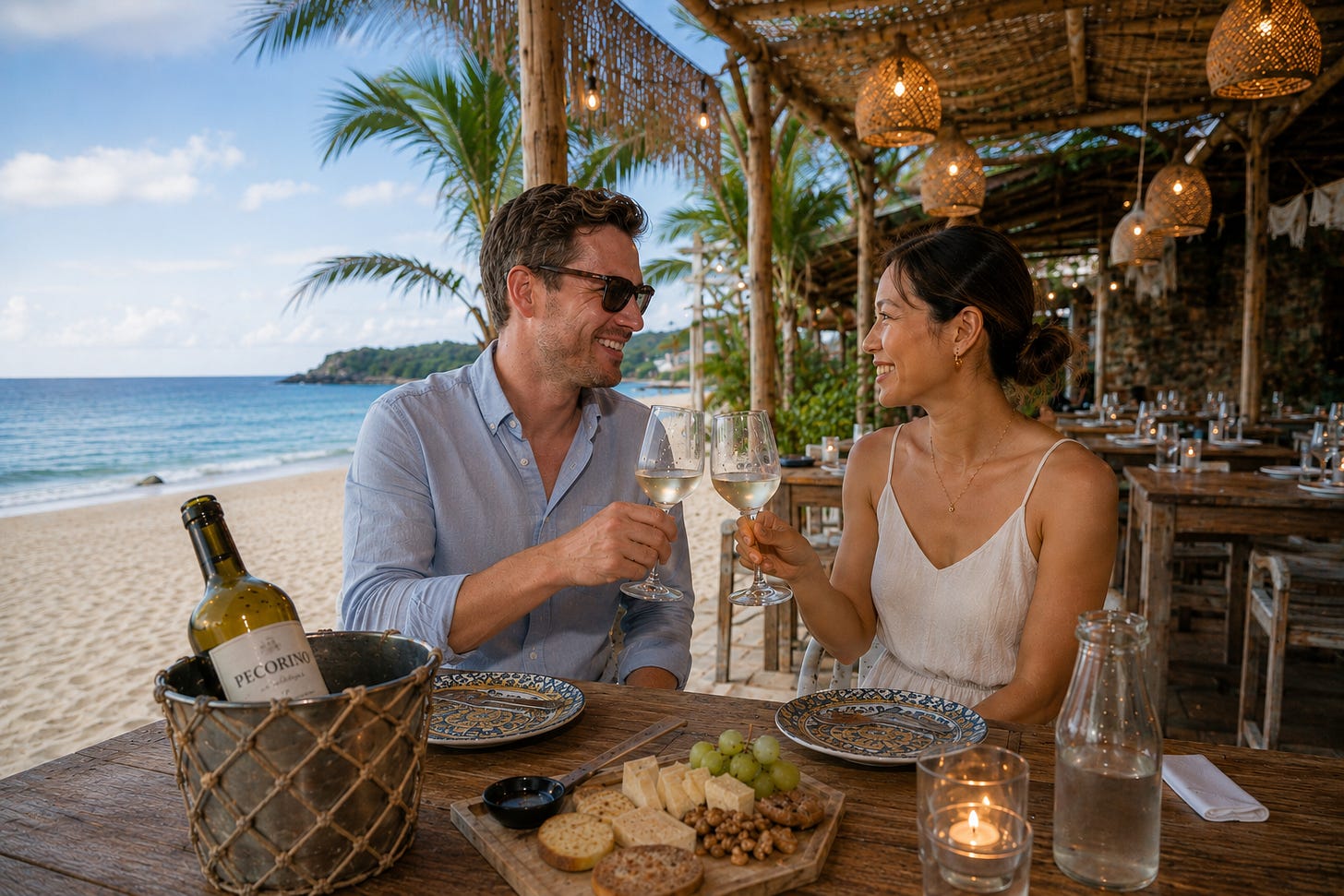
During a recent lunch at a small Italian restaurant on Vietnam’s Mui Ne beach, I spotted the name Pecorino on the wine list of. Some Italian insider joke, or perhaps an overly enthusiastic wine-and-cheese promotion? Maybe a wedge of cheese had wandered onto the wrong page of the menu, after the owner had enjoyed a little too much vino himself?
As it turned out, Pecorino is not only the essential cheese for iconic pasts dishes like Carbonara, Amatriciana, or Cacio e Pepe. It also is an official and perfectly legitimate Italian white grape. And to make things more confusing, there is a actual sheep connection too. The variety is native to central Italy, particularly the mountainous territory straddling Marche and Abruzzo. Its name is thought to derive from Pecora, Italian for sheep.
One poetic explanation for the name is that shepherds moving through the mountains noticed the sheep had a taste for these particular grapes. Whether that is oenological history or rural folklore I don’t know, but it’s more entertaining than many creative grape-name stories out there.
Pecorino is an old grape variety. Small berries, thick skins and naturally low yields make it capable of producing concentrated wines with decent acidity. Unfortunately, “low yielding” are two words that make farmers reach enthusiastically for other grapes. By the 1970s, Pecorino was edging toward extinction, unable to compete economically with more productive varieties. By 2000, only about 87 hectares remained planted in all of Italy.
Its survival owes much to winemaker Guido Cocci Grifoni in Marche. In 1982, he tracked down surviving Pecorino vines, took cuttings and began experimenting with them at his estate. By 1990, Tenuta Cocci Grifoni released about 1,800 bottles of varietal Pecorino. Its Colle Vecchio became one of the benchmark labels for the reborn grape.
Across the regional border, Luigi Cataldi Madonna became the Pecorino champion of Abruzzo. His first wine appeared in the 1990s, and he was the first to put the grape’s name prominently on the bottle. This helped turn an obscure local curiosity into a recognisable and tradable variety.
Today, Pecorino is no longer endangered, thanks to marketing hype and social media. Its principal territories remain Abruzzo and Marche, with Offida Pecorino DOCG among its most important expressions. The revival is so successful that the danger is now be the opposite, meaning planting it in warmer, flatter sites just because the name sells. Pecorino’s natural home is cooler hillside and mountain country, where its combination of ripeness and acidity works best.
If you’re shopping for it, look for Tenuta Cocci Grifoni Colle Vecchio, Cataldi Madonna Frontone and Tiberio Pecorino. In the glass, expect a medium dry white with citrus and orchard fruit, restrained acidity and a bit of a saline finish. The good ones carry noticeably more body than the bottle I’ve tried, and apparently they age rather well too.
Which brings us back to that beach in Vietnam. I ordered it because the name made me laugh. But my personal verdict on the taste was – let’s say – measured. Fine for a light beachside lunch, and I’d order it again under the same circumstances of sun, sand, and restrained expectations. But hand me a top Soave Classico, or even a decent Pinot Grigio, any day of the week.
I like knowing what I’m getting, and getting what I ordered. Viva!
Image Credit: https://www.churrascophuket.com (AI Generated)
_ _ _
© CHURRASCO PHUKET STEAKHOUSE / ALL RIGHTS RESERVED
Reprinting, reposting & sharing allowed, in exchange for a backlink and credits
Churrasco Phuket Steakhouse serves affordable Wagyu and Black Angus steaks and burgers. We are open daily from 12noon to 11pm at Jungceylon Shopping Center in Patong / Phuket.
We are family-friendly and offer free parking and Wi-Fi for guests. See our menus, reserve your table, find our location, and check all guest reviews here:
https://ChurrascoPhuket.com/
#Churrascophuket #jungceylon #phuketsteakhouse #affordablewagyu #wagyu